VR & HR: Practical Applications and Implementation
Table of Contents:
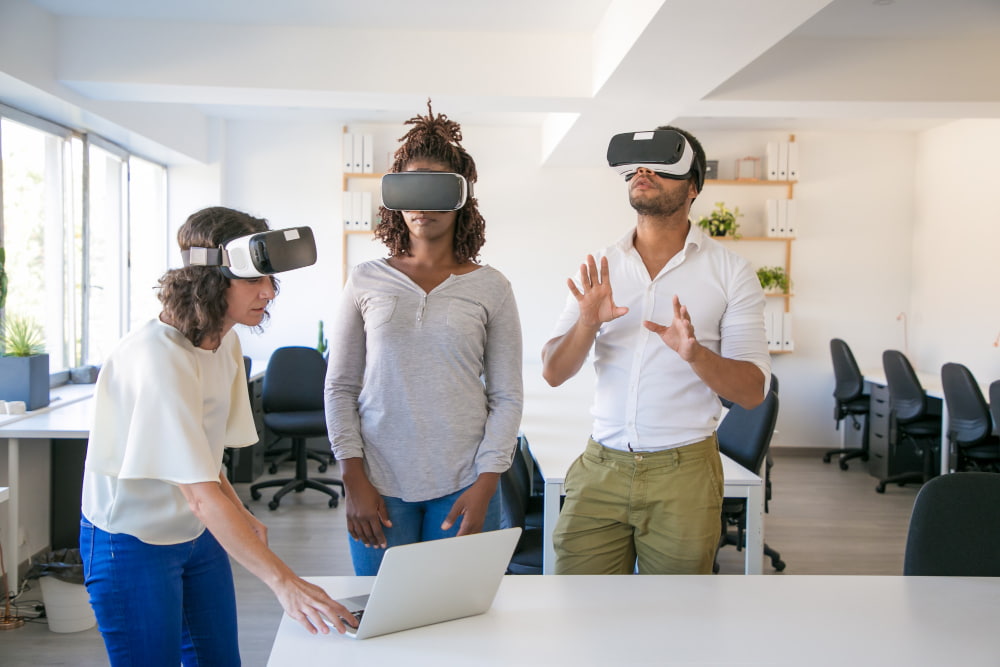
Technological advancements spur innovation in fields outside the technological sector itself. Access to new and revolutionary tools allows specialists from various disciplines to reimagine processes previously thought to be set in stone and incorporate innovative solutions. This is precisely the case of VR training in HR—with virtual reality steadily becoming more affordable and available, companies can greatly facilitate their training and onboarding efforts through immersive simulations. Today, we dig into the available VR solutions for employee training, as well as their benefits and use cases, and how they can create more engaging learning environments for new and existing hires. However, before we move on to training existing employees, it is worth mentioning how VR supports the recruitment process itself.
Key Takeaways
- VR is transforming HR beyond training, supporting recruitment, onboarding, and employee development through immersive, realistic experiences that go far beyond traditional methods.
- Virtual reality enhances hiring and onboarding, enabling more reliable candidate assessment, realistic workplace previews, and faster adaptation of new hires.
- VR training improves learning outcomes, offering better knowledge retention, high customisability, scalable global rollouts, and safe simulations of real-life workplace scenarios.
- Upskilling and reskilling through VR strengthen both businesses and employees, increasing competitiveness, job security, and fostering a culture of continuous learning.
- VR plays a growing role in DEI and employee well-being, helping organizations address unconscious bias, improve inclusion, and support mindfulness and work-life balance.
How does VR support hiring?
1. The recruitment process
In using VR for remote recruitment, testing potential employees’ knowledge and competencies becomes more real. This form of contact has a substantial impact on the senses of both interviewee and interviewer. It can evoke emotions just like in the real world, so the reliability of candidate’s answers increases significantly.
2. Virtual “tour guide”
Virtual reality is also a handy tool for showing candidates what their future workplace will look like. This is done using so-called virtual tours. While office work is quite schematic, fieldwork can often be challenging. Such a “virtual tour” gives applicants a preview of the future workplace and quickly verifies their expectations. The German railway company Deutsche Bahn used this to significant effect to attract younger generations to apply for a conductor’s position which did not seem attractive to them. As a result, the company received many applications from younger people.
3. Onboarding
An employee’s first days at work are crucial as they determine how quickly they will be able to adapt and start working correctly. Effective onboarding significantly reduces adaptation time and increases the productivity of new employees. Here, virtual reality can help. Instead of reading extensive publications or learning an organization’s culture “on their own”, a new employee can do it using VR. Jet.com, an American e-commerce company, has used VR in this way to show new employees what work looks like and how they will spend their time together at integration meetings.
Streamlined Onboarding of New Hires
Onboarding new employees is one of the most critical stages in the hiring process. VR training in HR transforms traditional onboarding programs by offering immersive education options. This comes with numerous benefits:
- Better knowledge retention
- Less time spent poring over boring presentations and documentation
- Improved global rollout for large businesses
- High customizability of VR training modules
These VR solutions for employee training can simulate real-life scenarios in a way a traditional training course never could. You can train employees to answer queries from challenging customers and prepare them for tough situations before they ever occur. The end result is a workforce that’s better equipped to confidently handle challenges from day one.
Upskilling and Retraining Using VR Solutions for Employee Training
As industries evolve, so must the skills of their workforce. Implementing VR reskilling and upskilling initiatives can provide hands-on learning experiences in a controlled environment.
Once again, the benefits really speak for themselves. First, by investing in workforce development, the business retains its competitive edge by sharpening its employees’ skills. Second, the employees themselves feel more secure and valued since they gain the opportunity to learn new skills at work. This reduces the stress associated with feeling at risk of being laid off while simultaneously giving them the tools they may benefit from in their careers going forward. Lastly, companies can foster a culture of continuous learning and adaptability and reap the reputational reward of simply being a great place to work.
Driving Inclusion Through DEI Training
In a global enterprise, promoting diversity, equity, and inclusion is essential for fostering a healthy workplace culture. Unlike traditional DEI programs, diversity inclusion training in VR offers an experiential learning approach—participants can engage in interactions from another person’s point of view, helping them uncover unconscious biases and improve interpersonal skills and relationships.
Organizations can simulate situations such as resolving conflicts in a diverse team or addressing microaggressions in the workplace. Overall, this cultivates a healthier workplace culture, but, importantly, is also easily scalable across the entire organization.
Encouraging Mindfulness and Work-Life Balance
In addition to professional training, VR can play a significant role in employee well-being, which you could argue is just as important as bringing up your workforce’s competence. Your company’s HR department can easily utilize VR solutions for stress relief and mindfulness exercises. As societal trends show, this issue holds particular sway over Gen Z employees who place significant value on their mental health.
This innovative use of VR solutions in employee training can help your personnel recharge during breaks by engaging in immersive activities like virtual nature walks or guided meditation sessions.
VR Training in HR – The Takeaway
Virtual and extended reality technologies continue to evolve. As they become more accessible, finding new applications to utilize their seemingly endless potential will become key for forward-thinking enterprises.
As you strive to set your business apart from the competition, going on this journey can position you for long-term success. But, it’s always best to brave the unknown with a guiding voice by your side. Reach out to us at Mazer for a free consultation and trial of our product, and discover just how much revolution you can introduce in your organization with our help.
What is VR training in HR?
VR training in HR uses virtual reality to create immersive learning environments for hiring, onboarding, and employee development. It helps people learn through realistic simulations instead of only reading documentation or watching presentations.
How does VR support recruitment and candidate assessment?
VR can make remote recruitment more realistic by enabling immersive interviews and competency testing. It can also help candidates experience job-specific scenarios, making it easier to verify expectations and assess decision-making under conditions that feel close to real work.
Why is VR effective for onboarding new hires?
VR onboarding reduces adaptation time by replacing passive learning with interactive experiences. New hires can learn workflows, culture, and key situations through simulations, which improves knowledge retention and helps them become productive faster.
How can VR help with upskilling and reskilling employees?
VR provides hands-on practice in a controlled environment, helping employees build new skills safely and confidently. This supports business competitiveness, strengthens employee security, and encourages a culture of continuous learning and adaptability.
Can VR support DEI training and employee well-being?
Yes. VR-based DEI training can help employees experience different perspectives and practise handling sensitive workplace situations. VR can also support well-being through mindfulness sessions and stress-relief experiences, helping employees reset during breaks and improve work-life balance.

Author: Rafał Siejca
Rafal has over twenty years of corporate experience, including roles at Millennium Bank, Comarch, and leading software teams at PZU, one of Europe’s largest insurance companies. As one of Poland’s few true VR experts with a decade of experience, he ensures timely, high-quality project delivery as CEO and CTO.