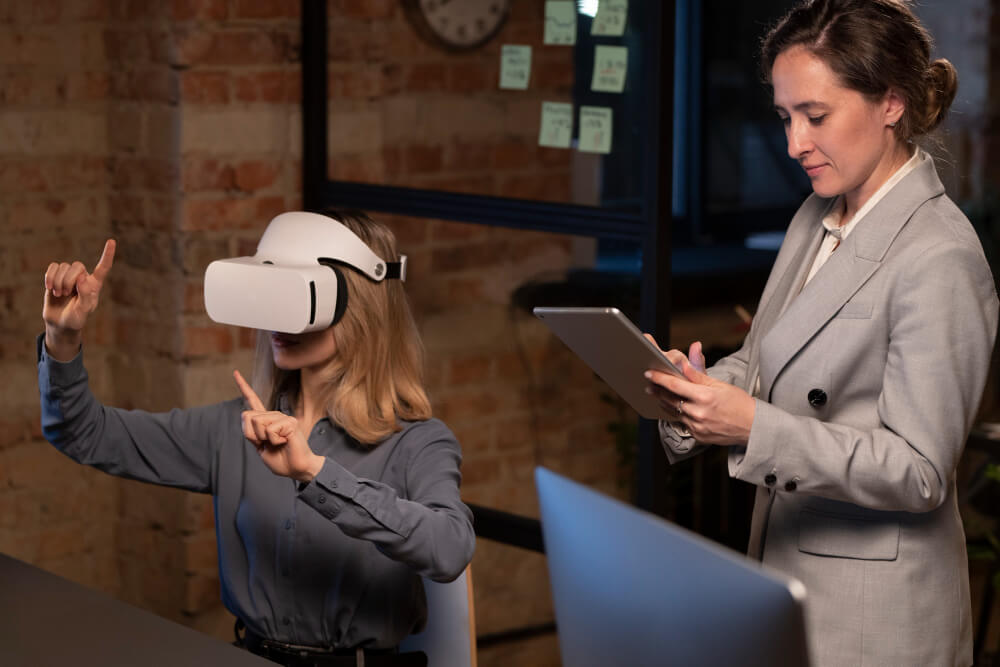
The Role of VR Training in Upskilling & Reskilling
Table of Contents:
VR upskilling offers employees an incredibly compelling opportunity to train new skills in as real a setting as can be without any of the consequences. The same goes for reskilling using virtual training—in the case of many customer-facing roles that require specific skills, placing your workers without giving them proper training would be a disaster. Through the use of AR technology, you can test the waters without exposing your teams to any of the risks. To learn more about VR’s role in upskilling and reskilling, read the rest of our article.
“The illiterate of the 21st century will not be those who cannot read and write but those who can’t learn, unlearn and relearn”
Alvin Toffler
Key Points:
- Future-Proofing the Workforce: As the job market evolves, the ability to learn, unlearn, and relearn is critical. VR provides a cost-effective, hands-on solution for developing “T-shaped” skill sets in realistic scenarios without real-world risks.
- Standardization and Scalability: Once a VR training module is developed, it can be rolled out across various global locations and departments. This ensures that standardized practices and procedures are maintained across an entire organization.
- Superior Learning Retention: Unlike passive methods like presentations or technical documents, immersive VR allows learners to interact with their surroundings and receive instant feedback, leading to much higher knowledge retention.
- Reskilling for the AI Era: As automation and AI take over routine tasks, VR training helps employees transition into higher-level roles, such as managing AI-powered machinery or handling complex customer service issues that require human insight.
- Supporting Global Transitions: VR is a vital tool for large-scale shifts, such as moving workers from traditional mining to green energy sectors or helping retail staff adapt to the logistics and digital marketing demands of e-commerce.
Benefits of VR Upskilling
As businesses evolve hand-in-hand with new technological advancements, upskilling and reskilling the workforce becomes both a pressing issue and a critical strategy needed to remain competitive. The problem lies in finding the right cost-effective training solutions to allow professionals to develop T-shaped skill sets as quickly as possible in real-world scenarios without undertaking unnecessary risks.
VR upskilling can form a comprehensive answer to these problems. As an innovative form of learning, the benefits of VR training are immense and should not be understated:
- Cost reduction: Implementing comprehensive training for employees to develop crucial skills requires hands-on practice. In sectors like manufacturing, healthcare, or aviation, creating such scenarios is either too costly or too risky, and VR upskilling takes care of both.
- Scalability: Acquiring the technology for VR training once allows organizations to scale their efforts across different locations and departments, enabling companies to maintain standardized practices and procedures across regions.
- Better knowledge retention: Immersive learning environments are undoubtedly more effective in what they’re designed to do than standard training methods. In VR, earners can interact directly with their surroundings and receive instant feedback, which makes it superior to listening to presentations or rifling through pages of technical documents.
Reskilling through Virtual Training
As per the main title, reskilling experienced employees through VR training technology is also possible, or in some cases, perhaps inevitable. As the looming threat of automation and AI comes ever closer for specialists in many industries, the transformation of the job market will drive many to seek solutions and try to avoid disruption.
Reskilling through virtual training could become one such solution, and not just as an answer to automation, but a wide selection of challenges which we outline below.
Automation and VR Reskilling
Automation is reshaping industries like manufacturing and logistics. As machines take over routine tasks, VR training helps new employees adapt by providing hands-on experience in operating or managing new technologies without real-world risks. For instance:
- Manufacturing: VR simulations can train workers to interact with AI-powered machinery in production lines.
- Customer Service: With basic inquiries handled by chatbots, VR can prepare workers for complex problem-solving that requires human insight.
Reskilling Beyond Automation
As mentioned, the use cases of reskilling go beyond adapting to AI’s increasing potential. Several industries are evolving in parallel to that, creating opportunities for immersive 360° VR training to revolutionize how we prepare people for vastly different jobs than the ones they held before:
- Sustainability: Workers will need to adapt to new, eco-friendly technologies as part of the ongoing greener energy shift. Moreover, VR training technology could also answer the need to retrain those employed in the mining industry as the world moves away from fossil fuels.
- E-commerce and Retail: As consumer behavior shifts ever more toward online shopping, retail workers may need to think about developing skills in digital marketing, logistics, and customer engagement. VR reskilling can simulate these new retail environments, offering experiential learning for the future of work.
The Takeaway
VR upskilling and reskilling initiatives certainly have the potential to bring about massive change. Facilitating the onboarding and re-training of employees within single organizations can be made tremendously easier for individual companies, though the benefits don’t end there. As we enter what is potentially an age of technological breakthroughs, reskilling the broader workforce to teach them to function in new roles can bring about much-needed large-scale social changes.
Are you ready to embrace the learning potential of virtual reality? Contact Us today and let’s explore options that will allow you to retrain your employees quicker and better than the traditional ways ever could!
What is the difference between VR upskilling and reskilling?
VR upskilling involves teaching employees new, advanced skills within their current field to enhance performance. Reskilling focuses on training experienced employees for entirely new roles, often as a response to industry shifts like automation or the move toward sustainability.
How does VR training reduce costs for manufacturing and aviation?
In high-stakes industries, hands-on practice with real machinery or aircraft is incredibly expensive and risky. VR provides a realistic simulation that eliminates the need for costly equipment downtime and removes the risk of physical accidents during the learning process.
Can VR help employees stay relevant in the age of AI and automation?
Yes. VR training allows workers to gain hands-on experience managing new technologies. For example, it can train factory workers to interact with AI-powered production lines or prepare customer service teams for complex problem-solving that chatbots cannot handle.
Why is knowledge retention higher in VR than in traditional training?
Immersive learning environments allow participants to physically interact with their virtual surroundings. This active participation, combined with instant feedback, creates a more memorable experience than passive methods like reading manuals or watching slides.
How does VR support the transition to green energy and e-commerce?
VR can simulate entirely new work environments, such as eco-friendly energy plants or digital e-commerce warehouses. This allows workers from declining industries, like mining or traditional retail, to acquire new technical and logistical skills safely and efficiently.

Author: Rafał Siejca
Rafal has over twenty years of corporate experience, including roles at Millennium Bank, Comarch, and leading software teams at PZU, one of Europe’s largest insurance companies. As one of Poland’s few true VR experts with a decade of experience, he ensures timely, high-quality project delivery as CEO and CTO.