The Education of the Future Goes Beyond Static Materials
Table of Contents:
Key Points
- The shift from static educational materials to immersive learning experiences is transforming corporate and academic education.
- The integration of VR and AI enables adaptive learning, allowing educational content to respond to individual student needs in real time.
- 3D spatial understanding enhances learning by allowing students to explore complex concepts in a more engaging and interactive manner.
We are currently witnessing the sunset of the “static” era of corporate and academic education. For nearly a century, learning was defined by passive consumption: reading textbooks, watching recorded videos, and sitting through slide decks. These materials exist outside the learner, requiring a massive cognitive effort to translate abstract theory into practical application.
In 2026, the evolution of e-learning has shifted toward spatial computing, creating an education ecosystem that responds to learners in real time. This shift marks the transition from “learning about” the world to “interacting with” the world.
From Passive Consumption to Active Experience
The fundamental flaw of static materials is that they rely on “listening and remembering,” a process where the brain retains only a fraction of information after 30 days. However, the human brain is not a computer drive; it is an organ designed to learn through experience, trial, and emotional connection. This is the core of what immersive learning is: the understanding that humans learn faster when they are mentally and physically “present” in a scenario.
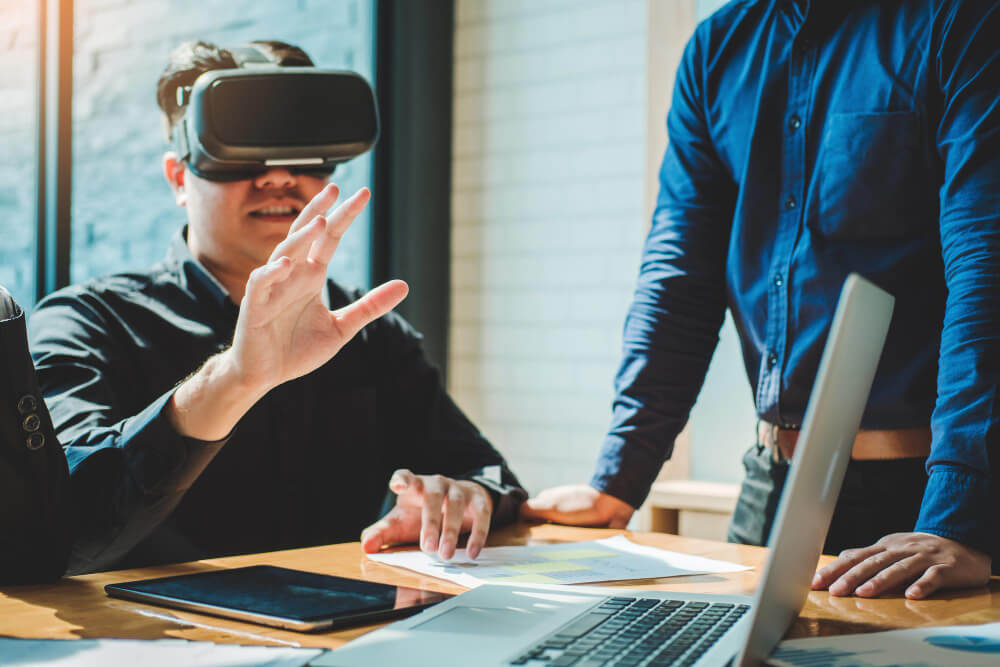
When a student uses VR in higher education, they don’t just read about the ruins of ancient Rome; they walk through them, touch the marble, and hear the sounds of the forum. In a corporate setting, a technician doesn’t just watch a video on how to repair a high-voltage transformer; they reach out, manipulate the components, and feel the scale of the machinery. This transition from “viewing” to “doing” is the most significant leap in educational history, effectively eliminating the “boredom barrier” that plagues traditional classrooms.
Adaptive Learning and AI Synergy
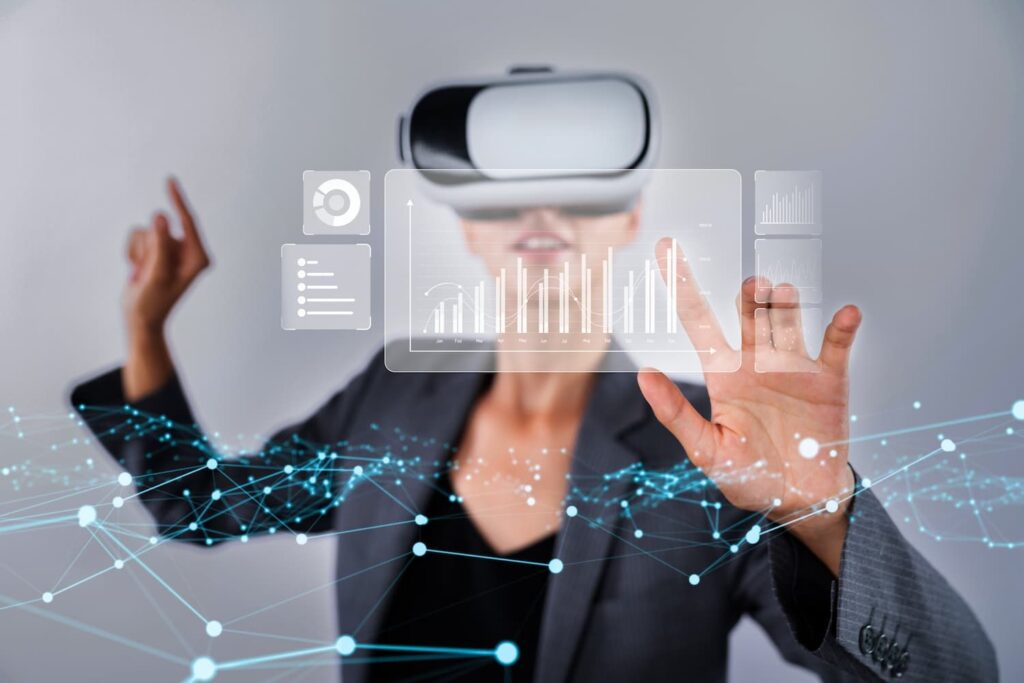
Static materials are rigid. Once a video is filmed or a PDF is written, it cannot be adapted for a struggling student. However, the intersection of VR and AI has created a world of “Adaptive Immersive Learning.” By integrating generative AI and VR, educational content becomes infinitely variable and responsive.
Imagine a medical student practicing a complex procedure in a VR medical training module. If they excel, the AI increases the complexity by simulating a sudden complication. If they struggle, the system provides instant, context-aware coaching or simplifies the environment to prevent cognitive overload. This ensures that how to use VR for continuous learning remains effective for every individual, regardless of their starting skill level. We are moving toward a future where the curriculum evolves with the student.
The Power of 3D Spatial Understanding
The human world is three-dimensional, yet our education has been flattened into 2D for centuries. The shift from 2D to 3D training enables the development of spatial intelligence that is not possible with a textbook. For how to use virtual reality in education, this means complex concepts like molecular biology, aerospace engineering, or quantum physics can be explored from the inside out.
Beyond individual learning, the future includes multi-user environments in which virtual reality team building occurs naturally during the learning process. Whether it is mastering VR fire safety training protocols or practicing surgical techniques, 3D environments provide a sense of scale and depth that cements knowledge in long-term memory. Platforms like Mazer Trainer now empower organizations to create custom VR courses that mirror their specific physical work environments. The education of the future is no longer a digital replica of a book; it is a living, breathing world of discovery.
What is the main flaw of static educational materials?
How does immersive learning improve education?
What role does AI play in adaptive immersive learning?
What advantages does 3D training offer over traditional 2D education?

Author: Rafał Siejca
Rafal has over twenty years of corporate experience, including roles at Millennium Bank, Comarch, and leading software teams at PZU, one of Europe’s largest insurance companies. As one of Poland’s few true VR experts with a decade of experience, he ensures timely, high-quality project delivery as CEO and CTO.