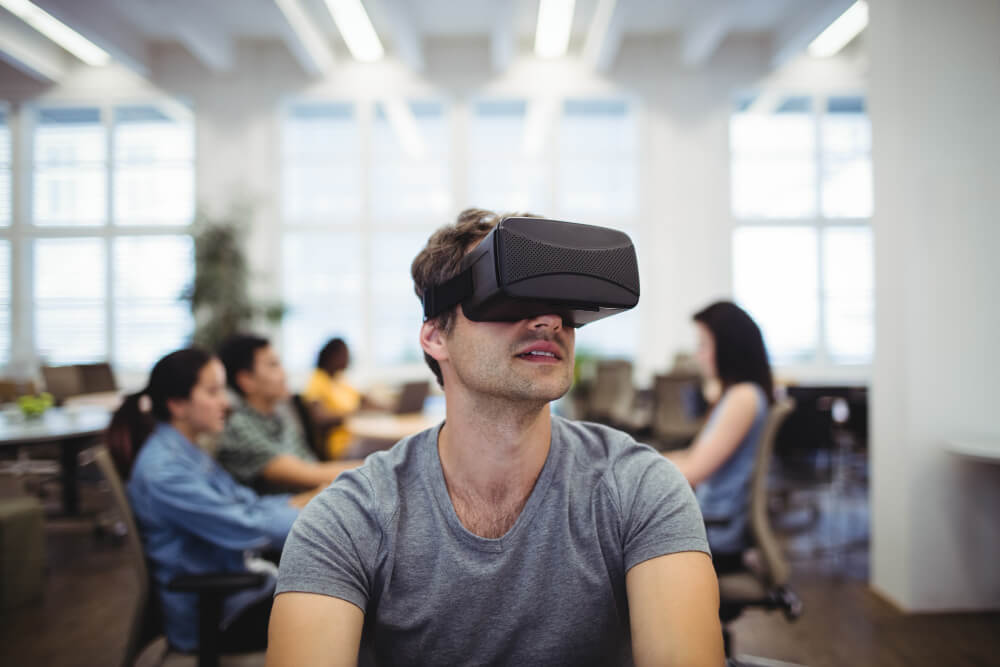
VR in Higher Education
Table of Contents:
Key Points
- Virtual reality (VR) is becoming a fundamental tool in universities, enhancing hands-on learning in various fields while reducing costs and safety risks.
- VR technology helps combat student distraction by providing immersive environments that improve focus and academic performance.
- The evolution of digital campuses through VR allows for global collaboration, making high-quality education more accessible and inclusive.
The use of virtual reality in universities has reached a critical mass as academic institutions seek more engaging ways to teach a new generation of students. A review of the educational landscape from 2020 to 2025 shows that VR has become a staple tool for laboratories, technical training, and scientific research. This is no longer an experimental technology used by a few early adopters in computer science departments. It is now a central part of how modern universities provide hands-on experience in fields that are traditionally expensive or dangerous to teach in a physical classroom. From architecture to archeology, the ability to step inside a subject matter has fundamentally changed the student experience.
A Long-Term Shift in Academic Standards
Academic institutions are increasingly seeking ways to align their teaching with the Sustainable Development Goals and digital transformation. By mastering how to use virtual reality in education, universities can provide students with unlimited practice in digital labs without the cost of physical materials. This approach is both environmentally friendly and economically sound for large departments serving thousands of students. It allows for a level of experimentation that would be impossible in a traditional setting due to safety risks or the high cost of specialized equipment. Students can now perform complex chemical reactions or structural stress tests as many times as they want without any waste.
Combating Student Distraction
One of the most significant problems in higher education today is the difficulty of keeping students focused during long lectures or complex digital labs. Research indicates that VR and AR can eliminate educational distractions by placing the student in a fully encapsulated environment that blocks out the outside world. Inside a headset, there are no phone notifications, no peer conversations, and no external interruptions to break the flow of learning. This complete immersion leads to significantly higher concentration levels and better overall academic performance for students across all disciplines. By creating a dedicated space for focus, VR helps students engage more deeply with difficult material.
The Evolution of the Digital Campus
The traditional classroom is expanding into new and collaborative digital spaces that go beyond physical walls and geographic boundaries. The study of the metaverse and education shows how virtual campuses enable students from around the world to collaborate in real time. This removes geographical barriers and gives every student access to the same high-quality equipment and instruction regardless of their location or social status. It is a major step toward making elite-level education more accessible and inclusive for a global audience. This collaborative dimension allows for international research projects that were previously too expensive to coordinate.
Supporting Engineering and Medicine
In technical and professional fields, the benefits of immersion are even more pronounced for students. Virtual reality supports the development of critical thinking and problem-solving skills by allowing engineering students to test theoretical designs in low-risk virtual labs. Similarly, medical students can walk through anatomical models in three dimensions to better understand spatial relationships that are not visible on a flat page. These tools do not replace traditional study but instead provide a vital practical layer that enhances theoretical knowledge with experiential data. This ensures that when students enter the workforce, they have already encountered and solved practical problems in their field.
Modern Methods for a New Generation
Mazer Space is committed to helping universities stay at the cutting edge of these pedagogical trends and technological advancements. We provide the infrastructure professors need to create engaging, interactive simulations that meet today’s digital-native students’ needs. VR in higher education is not a temporary trend but a permanent change in how we prepare the next generation for their professional lives in a digital economy. By providing the tools for immersive creation, we allow universities to remain centers of innovation. The schools that embrace these methods today are the ones that will attract the brightest minds of tomorrow.
Upgrade your university’s teaching tools. Check out our Education Services and see how Mazer Trainer can modernize your curriculum.
How has virtual reality changed the educational landscape in universities?
What are the benefits of using VR in education?
How does VR help in combating student distraction?
What role does Mazer Space play in the integration of VR in higher education?

Author: Rafał Siejca
Rafal has over twenty years of corporate experience, including roles at Millennium Bank, Comarch, and leading software teams at PZU, one of Europe’s largest insurance companies. As one of Poland’s few true VR experts with a decade of experience, he ensures timely, high-quality project delivery as CEO and CTO.