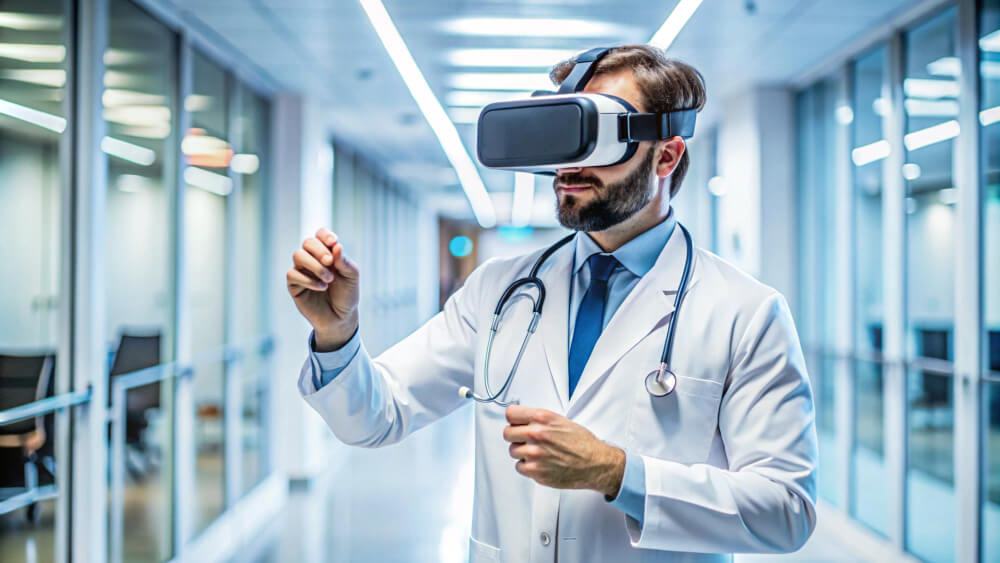
How VR Training Enhances Doctor-Patient Communication
Table of Contents:
Key Points
- Virtual reality (VR) is an effective tool for training medical and nursing students in essential communication skills like empathy and negotiation.
- VR simulations provide a safe environment for students to practice high-pressure interpersonal interactions, improving their readiness for real-world patient care.
- The use of data in VR training allows for precise tracking of student progress and offers objective feedback to enhance communication skills.
Medical expertise involves more than just clinical knowledge, pharmacological understanding, and surgical precision. New research indicates that VR is an effective tool for training medical and nursing students in essential communication skills like empathy, negotiation, and handling difficult news. These simulations provide a safe environment where students can practice interpersonal interactions that are usually high-pressure and extremely sensitive. By refining these skills in a virtual setting, future healthcare providers arrive at the clinic better prepared for the human side of medicine. This preparation reduces the likelihood of patient dissatisfaction and improves the overall quality of care delivered in high-stress environments.
Developing Empathy Through Simulation
Communication skills are often neglected in traditional medical curricula because they are challenging to teach in a large, lecture-based classroom. Using virtual reality soft skills training allows students to interact with diverse virtual patients who display realistic emotional responses. This immersion forces a student to consider their word choice, body language, and tone in ways that reading a textbook cannot. It turns a theoretical lesson on empathy into a practical experience that leaves a lasting impression on the learner’s professional behavior. By experiencing the consequences of poor communication in a simulation, students become more mindful of their impact on real patients.
High-Stakes Conversations and Truth-Telling
Some conversations in a hospital are too critical to practice on a real patient or a grieving family member for the first time. A specialized VR in a medical trainingenvironment allows a student to repeat a difficult consultation, such as delivering a cancer diagnosis, as many times as needed to get it right. This repetition builds the necessary confidence to remain calm when facing similar situations in real life. It is about establishing a standard of care that prioritizes the patient’s emotional well-being alongside their physical health. These simulations can include complex variables, such as cultural differences or high levels of distress, to ensure the training is as realistic as possible.
Using Data to Improve Interaction
One benefit of digital training is the ability to track progress with high precision and provide objective feedback. By using VR for real-time feedback, instructors can analyze a student’s performance data to offer specific suggestions for improvement. Instead of general advice, students get a clear look at their decision-making patterns during a simulation, including their eye contact and response times. This level of detail helps them understand exactly how their communication style affects patient outcomes and satisfaction levels. This data-driven approach allows for a more standardized evaluation of soft skills across an entire graduating class.
Reducing Anxiety in Students
Working in a clinical setting for the first time can be an overwhelming and anxiety-inducing experience for many medical students. Virtual reality provides a high level of realism and immersion, effectively reducing students’ apprehension when facing challenging clinical scenarios. When a student feels comfortable in the virtual room, they are more likely to take risks and experiment with different communication techniques that they might be too intimidated to try in person. This leads to a much more confident transition to real-world patient care, where the stakes are much higher. By lowering the psychological barrier to entry, VR helps create more resilient and capable healthcare professionals.
The Versatility of Immersive Tech
The success of VR in medical schools proves that this technology is not just for technical drills or surgical practice. At Mazer, we see immense potential for our platform to be used wherever human connection and soft skills are the primary goals of the training. Whether it is a doctor practicing a diagnosis or a nurse managing a difficult family interaction, VR provides the necessary realism to change behavior. It is a universal tool for any profession that relies on effective human communication to achieve its objectives. As the healthcare industry continues to move toward more patient-centered models, the demand for these immersive communication tools will only grow.
Improve patient care with better communication. Discover our Health Care Services and see how Mazer Space can support your medical training goals.
How does VR help in developing empathy among medical students?
What type of conversations can be practiced using VR in medical training?
What advantages does VR provide in terms of feedback for students?
How does VR reduce anxiety for medical students?

Author: Rafał Siejca
Rafal has over twenty years of corporate experience, including roles at Millennium Bank, Comarch, and leading software teams at PZU, one of Europe’s largest insurance companies. As one of Poland’s few true VR experts with a decade of experience, he ensures timely, high-quality project delivery as CEO and CTO.