10 Examples of Augmented Reality Applications
Table of Contents:
Augmented reality is no longer a revolution – it is the present, it is available at our fingertips. Due to its effectiveness and helpfulness, it has become widely used in numerous industries and for various purposes. In this article, we present 10 examples of augmented reality applications to underline AR’s role in the modern world. We encourage you to read on.
Key Takeaways
- Augmented reality is already part of everyday life. AR has moved beyond experimentation and is now widely used in consumer apps, business tools, and industry solutions, delivering real, practical value.
- AR effectively bridges the physical and digital worlds. By overlaying digital information onto real environments, it enhances understanding, interaction, and decision-making across multiple contexts.
- Its impact spans many industries. From gaming and retail to healthcare, education, navigation, marketing, and manufacturing, AR improves user experience while increasing efficiency and accuracy.
- AR adoption will continue to accelerate. Growing accessibility through smartphones, popular platforms, and enterprise tools positions augmented reality as a long-term technology that will increasingly replace traditional processes rather than merely support them.
What is AR?
Augmented reality is the technology used to enhance the phygital world. Typically, it scans the surroundings and adds digital elements to them, which enhances user experience and creates fun games but also helps in business. You can learn more in our article: What Is Augmented Reality?
Our 10 Examples of Augmented Reality Applications
How exactly is augmented reality used? We have prepared 10 examples presenting the most interesting cases, which are either worth exploring further or completely changed the way particular niches function.
1. Gaming – Pokemon GO
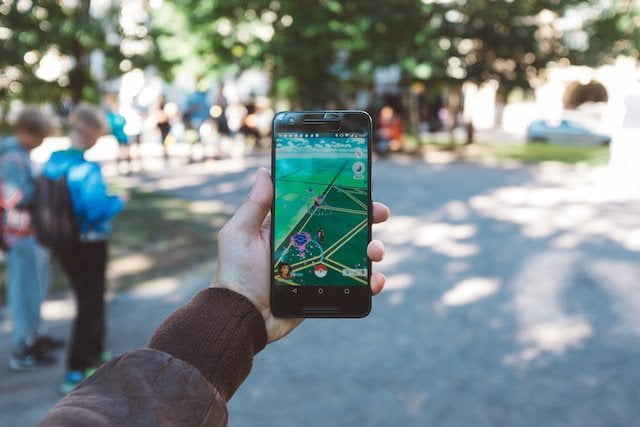
Launched in 2016, Pokemon GO is an excellent example of augmented reality applications in gaming. The game itself combines traveling around your neighborhood or city and scanning the surroundings to find Pokemon, which you may catch. Why is it so important?
This game has utilized augmented reality to introduce a phygital gaming experience. While users were still playing in their apps, they actually had to travel around physical locations to catch the desired Pokemons, get to the gyms, or complete missions. Through that, they met other players who were exploring their surroundings as well – proving how AR can be utilized for creating seamlessly integrated experiences between the physical and digital worlds and above all – making the players make new, real-life friendships.
2. Interior Design – IKEA Place
The leading world furniture manufacturer and retailer has also leveraged AR, this time in the form of the interior design app IKEA Place. How does it work?
It is an application that enables its users to make truly informed decisions when purchasing pieces of furniture. Customers may select different items and see how they would fit into a given space – the app renders the room and scales the pieces of furniture, giving the users the opportunity to test their interior designs.
Why is it important? This is one of the most noteworthy examples of how AR may be leveraged by large businesses to drive sales and increase customer satisfaction.
3. Healthcare – AccuVein
The third example of AR application that needs to be mentioned is AccuVein – a scanner used for delivering IVs. It is designed to spot veins and localize them for the nurses. Why is it effective?
By traditional means, nurses tend to miss the veins on the first or even second try. With AccuVein, this is no longer a problem since all they have to do is look into the scanner and inject wherever it shows the veins.
4. Education – Arloon Geometry
There are numerous ways in which augmented reality may be applied to education, most of which can enhance the learning experience and make the knowledge feel more “hands-on.” Therefore, we will limit ourselves to one particular example – Arloon Geometry.
This application’s main advantage is that it develops spatial intelligence by letting students play with and operate on geometrical (2D and 3D) models displayed in their classroom setting. This gives them insight into the relation between such a model and the real dimensions of their desks, chairs, etc.
5. Fashion – Zalando “Try On”
Finally, proceeding with fashion. There are different applications of augmented reality in this industry, yet our focus will be on a particular example involving a smartphone and the popular Snapchat app – Zalando “Try On.”
This popular addon, similar to virtual fitting rooms, gives users the opportunity to try on the clothes. Why is it so good? Firstly, because Zalando is an e-commerce platform, so customers would not be able to try the clothes otherwise; secondly, because it utilizes Snapchat, which most people have anyway, making this option easily accessible.
6. Navigation & Mobility – Google Maps Live View
Another strong and very practical example of augmented reality applications is Google Maps Live View. This feature enhances pedestrian navigation by overlaying directional arrows, street names, and distance markers directly onto the real-world view captured by a smartphone camera.
Instead of interpreting a flat map, users can simply lift their phone and follow AR guidance displayed on streets and buildings around them. This significantly reduces confusion, especially in unfamiliar urban environments, large campuses, or tourist-heavy areas.
Why is it important? Live View shows how AR can solve everyday problems at scale. It improves usability, saves time, and lowers the cognitive load associated with navigation, proving that augmented reality is not only about entertainment or experimentation, but also about real-world efficiency.
7. Social Media & Marketing – Instagram AR Filters
Augmented reality has also become deeply embedded in social media and digital marketing, with Instagram AR filters being one of the most recognizable examples. These filters allow users to interact with virtual objects, animations, or branded experiences layered onto their faces or surroundings in real time.
From virtual product try-ons and branded effects to interactive storytelling campaigns, Instagram AR has changed how brands communicate with audiences. It turns passive viewers into active participants and encourages organic content sharing.
This use case proves that AR is not only a technological innovation, but also a powerful communication and engagement tool, especially for younger, mobile-first audiences.
8. Museums & Cultural Heritage. Google Arts & Culture AR
A more educational and cultural example is Google Arts & Culture AR. This application allows users to view historical artifacts, artworks, and monuments as life-size AR models in their own environment.
Instead of seeing objects behind glass or in static images, users can walk around them, inspect details, and interact with contextual information. Museums and cultural institutions use this tool to extend exhibitions beyond physical spaces and make heritage accessible worldwide.
Why is it important? This use case shows how AR can democratize access to education and culture, turning passive observation into interactive exploration.
9. Real Estate & Architecture. Zillow 3D Home and AR View
Augmented reality is also reshaping the real estate market. Zillow 3D Home and AR View enables users to explore properties using immersive 3D models and AR-based room visualization.
Potential buyers can preview layouts, understand room proportions, and even visualize furniture placement before visiting the property. This bridges the gap between online listings and physical walkthroughs, helping users make better-informed decisions earlier in the buying process.
This example highlights how AR supports decision-making in high-value transactions, reducing uncertainty and saving time for both clients and agents.
10. Manufacturing & Quality Control. Scope AR WorkLink
Another strong example of augmented reality applications in industry is Scope AR WorkLink. This solution is designed for manufacturing, quality control, and assembly processes, where precision and repeatability are critical.
WorkLink allows workers to see AR-guided instructions directly on physical products or machines. Instead of switching between paper manuals or screens, employees receive contextual, step-by-step guidance in their field of view. This significantly reduces human error, shortens onboarding time, and improves consistency across production lines.
Why does it matter? This application shows how AR can directly impact operational efficiency and quality, especially in environments where mistakes are costly and training time is limited.
Augmented Reality Applications: The Takeaway
These are only a few of the examples of augmented reality applications in different industries. Nevertheless, this technology has already proven its worth, and we might expect it to become even more significant – perhaps even surpassing its predecessors and substituting old ways, such as traditional fitting rooms, for good.https://www.traditionrolex.com/38
You may also read: Augmented Reality In The Food Industry
What is AR?
Augmented reality is the technology used to enhance the phygital world. It scans the surroundings and adds digital elements to enhance user experiences and is utilized in various industries.
How is augmented reality used in gaming?
Augmented reality in gaming is exemplified by games like Pokemon GO, which combine the physical and digital worlds. Players explore real-world locations to catch virtual Pokemon, fostering social interaction and merging the two realms seamlessly.
what are examples of augmented reality applications?
Examples of augmented reality applications include gaming (e.g., Pokemon GO), interior design (e.g., IKEA Place), healthcare (e.g., AccuVein), education (e.g., Arloon Geometry), and fashion (e.g., Zalando “Try On”).

Author: Rafał Siejca
Rafal has over twenty years of corporate experience, including roles at Millennium Bank, Comarch, and leading software teams at PZU, one of Europe’s largest insurance companies. As one of Poland’s few true VR experts with a decade of experience, he ensures timely, high-quality project delivery as CEO and CTO.