Creating Immersive and Impactful VR Training Experiences
Table of Contents:
With the addition (and steadily increasing adoption) of advanced VR learning systems across various industries, companies relying on this technology place themselves on the frontier of change in the business sector. However, it’s not enough to take this revolutionary tech for granted and hope that it’ll do the job sufficiently well by itself. While the potential of virtual reality in training initiatives is incredible, it’s all about creating immersive education through VR to reap the maximum benefits. To learn more about going far beyond the basics matters, read the rest of the post below!
Key Points:
- Establish a Strategic Foundation: A VR learning system is only as effective as the strategy behind it. Success starts with clearly defining your training objectives, whether that means targeting specific skill gaps, improving safety protocols, or overhauling the onboarding process.
- Supporting the Silver Generation: Custom VR modules are highly adaptable and serve as an excellent tool for reskilling older employees. This is increasingly vital for maintaining a strong workforce amid ongoing global demographic shifts.
- The Pilot-to-Launch Methodology: To ensure a smooth rollout, organizations should first test their VR programs with a smaller pilot group. This allows management to identify friction points, optimize the content, and perfect the modules before deploying them workforce-wide.
- Maximize Realism and Interactivity: To truly leverage VR, simulations must be as realistic and interactive as possible. This allows professionals in high-stakes fields—like healthcare, manufacturing, or emergency response—to practice hazardous scenarios and refine their reactions without real-world danger.
- Fostering Team Collaboration: VR training extends far beyond solo onboarding. Advanced systems are powerful tools for team building, enabling group crisis management drills, cross-departmental collaboration, and leadership development in a shared immersive space.
The Foundation of Immersive Education Through VR
A successful VR training program begins with understanding your organization’s specific needs. It’s essentially the only way to maximize the potential of a VR learning system—otherwise, it won’t amount to much more than a glorified toy.
Advanced VR learning systems, like Mazer Trainer, offer a wide array of customization options, allowing companies to tailor their modules to target skill gaps, address safety concerns, or enhance onboarding processes. This is particularly important for employees from the Silver Generation, whose role in the workforce is as important as ever in many parts of the world due to the ongoing demographic crisis.
The key steps to building effective VR training include:
- Identifying Training Objectives & Needs: First, define clear goals, such as improving technical skills or training employees in challenging situations.
- Choosing the Right VR Tools: Knowing how to choose the right VR training center is paramount to your success. Understand the system’s functionality and make sure it aligns with your goals.
- Piloting and Optimization: If possible, test the program with a smaller group to identify what needs tweaking. Then, once you’re ready to launch, roll it out to the entire workforce.
Admittedly, this process poses a bit of a challenge for first-timers. There are loads of questions to address, but not many answers. If you want your launch to go as smoothly as possible, contact us at Mazer. We’ll gladly show you the ropes of our innovative training system, walk you through module creation and customization, and set you on the right path to giving your HR and training initiatives a complete makeover!
Enhancing Engagement Through Interactivity
The whole idea behind this technology is to create a much more immersive, VR-based experience to achieve training goals quicker and more efficiently. This means, if you do not put sufficient effort into making your simulated practice as real as possible, you’re missing out on its tremendous potential.
To truly leverage the opportunities of VR in workforce development, you need to go all-in on the simulated reality aspect. This is particularly beneficial in sectors like healthcare, emergency response, or manufacturing. Why? By recreating hazardous scenarios in VR, learners can test and improve their reactions to dire circumstances without exposing themselves or others to danger.
Just imagine the potential in medicine: if doctors in training could spend hours preparing for a difficult surgery in an accurate simulation, their success rate in the real world would surely skyrocket.
Leveraging Advanced VR for Team Collaboration
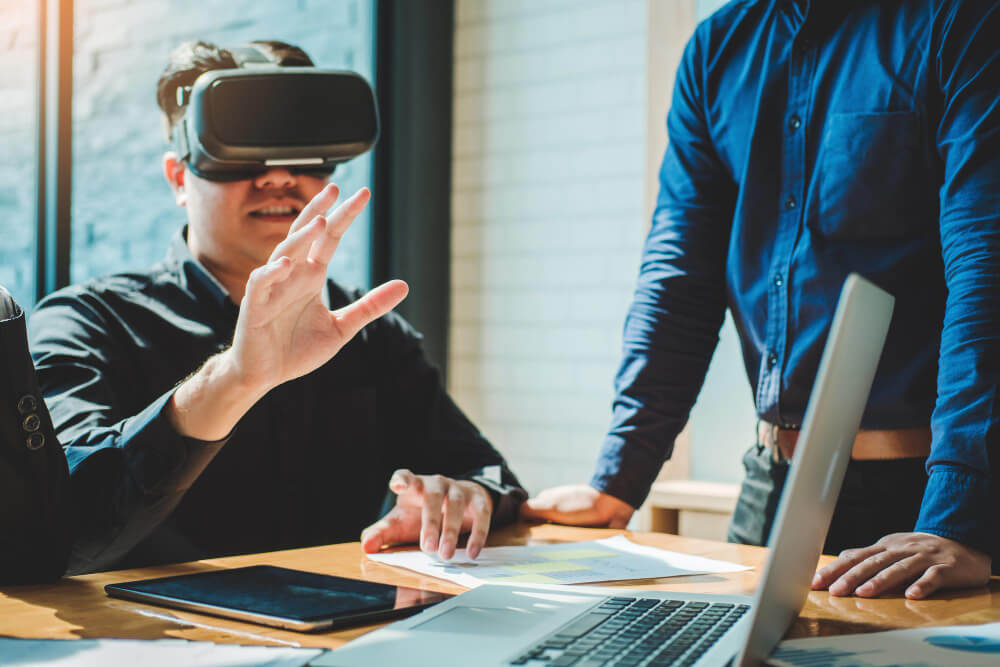
Aside from onboarding new employees using VR, most use cases will revolve around training entire teams and departments. Therefore, it’d be an enormous waste to neglect this tool’s potential for fostering team building.
Team VR training initiatives can include group crisis management drills, cross-departmental collaboration, and leadership development, just to name a few. Each of these fulfills different goals, but the end result is the same: a stronger, more coherent, and team-oriented workforce that performs better under pressure.
Advanced VR Learning Systems – The Takeaway
Immersive education through VR is transforming the landscape of employee training, offering unmatched realism, interactivity, and scalability. By thoughtfully leveraging advanced VR learning systems, organizations can foster a highly skilled, collaborative, and motivated workforce.
What is the first step in building a successful VR training program?
The foundation of a successful program is understanding your organization’s specific needs. You must clearly identify your training objectives, such as addressing safety concerns, targeting skill gaps, or improving technical proficiencies.
How does VR training help the “Silver Generation”?
Advanced VR systems offer highly customizable, accessible learning modules that are excellent for reskilling older employees. This helps maintain their crucial role in the workforce, especially in the face of ongoing global demographic crises.
Why should a company pilot a VR training program before a full launch?
Piloting the program with a smaller group allows management to identify areas that need tweaking. Gathering this early feedback ensures the modules are optimized and effective before rolling them out to the entire workforce.
Why is realistic interactivity so important in VR training?
If a simulation isn’t highly realistic, it misses the core potential of immersive learning. Realistic interactivity allows learners—especially in healthcare or manufacturing—to practice their reactions to hazardous or dire circumstances without exposing anyone to actual danger.
Can VR be used for team building and group training?
Yes, advanced VR systems are fantastic for team collaboration. They can be used to run group crisis management drills, foster cross-departmental collaboration, and develop leadership skills, resulting in a more cohesive, team-oriented workforce.

Author: Rafał Siejca
Rafal has over twenty years of corporate experience, including roles at Millennium Bank, Comarch, and leading software teams at PZU, one of Europe’s largest insurance companies. As one of Poland’s few true VR experts with a decade of experience, he ensures timely, high-quality project delivery as CEO and CTO.